
Weed Mat for Farm Pathways & Mulching: Smart Dual Use
Ask a grower where their weeding labour actually goes and the answer surprises people: not the beds — the paths, headlands and the strips around structures. Bed weeds get a hoe eventually; path weeds just get walked on and regrow flat. Meanwhile the mulch question keeps coming back every season — plastic film every year, or nothing. A single weed mat roll quietly solves both problems at once, and it is the use-case our farm customers under-use most. Here is the dual-use system.
Paths first: the problem nobody budgets for
Farm paths are the perfect weed habitat — compacted soil, regular irrigation splash, zero crop competition. By mid-monsoon, a typical inter-row path carries a dense flat-weed carpet that slows every trolley run, hides snakes (a safety issue our customers in cane and vegetable belts raise seriously), and sheds seed into your beds continuously. Hand-hoeing paths is the worst labour-to-result ratio on the farm. Mat the paths and three things happen: trolleys and sprayer lines run clean all season, the path surface stays firm and walkable an hour after rain, and the seed pressure on adjacent beds drops visibly.
The path setup
- Path width minus nothing: A 1-metre roll matches standard inter-row paths exactly — one roll covers 100 running metres of path. Wide headland roads take two parallel runs with a 10 cm overlap.
- Light prep only: Paths do not need bed-level prep — cut the tall growth, rake the worst humps, roll the mat, pin edges every 1-1.5 m (heavier pinning at turns, where trolley wheels pivot and stress edges — see the fixing guide).
- Drainage consideration: On sloping paths, lay rolls shingle-style — upper roll overlapping lower by 10 cm — so water flows over seams, not into them.
Then mulching: the multi-season version
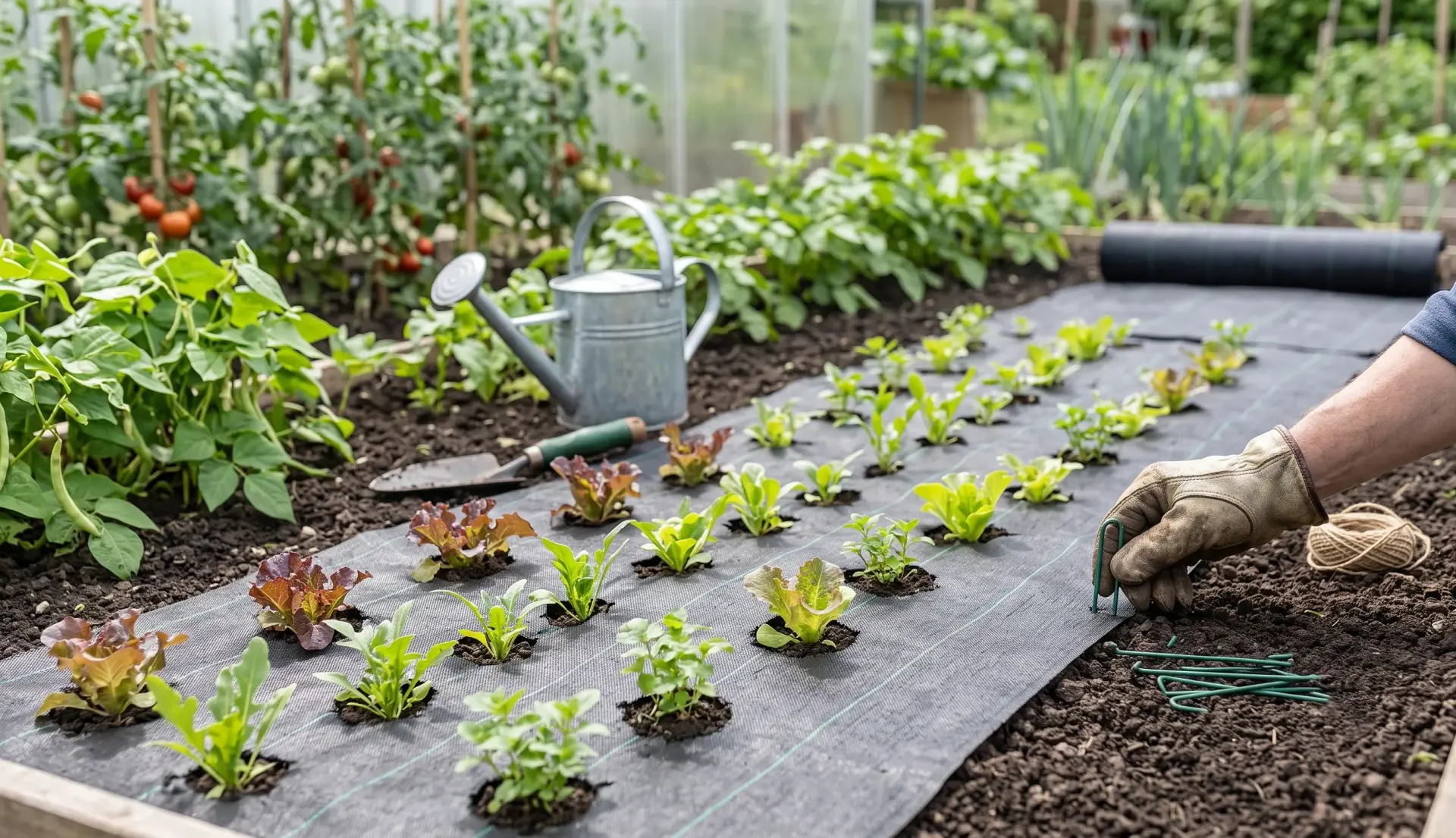
Every grower knows mulch logic — covered soil holds moisture, moderates temperature, and blocks weeds. The problem has always been material. Organic mulch decomposes, invites termites near stems, and needs refilling every season. Plastic film works one season, then tears into landfill. Woven mat is the mulch that behaves like infrastructure: it passes irrigation and rain through to the root zone, blocks evaporation above it, suppresses weeds for years, and rolls up for storage or re-laying between crop cycles. Our full comparison runs the three materials head-to-head; the short version is that mat costs more on day one and wins every season after the second.
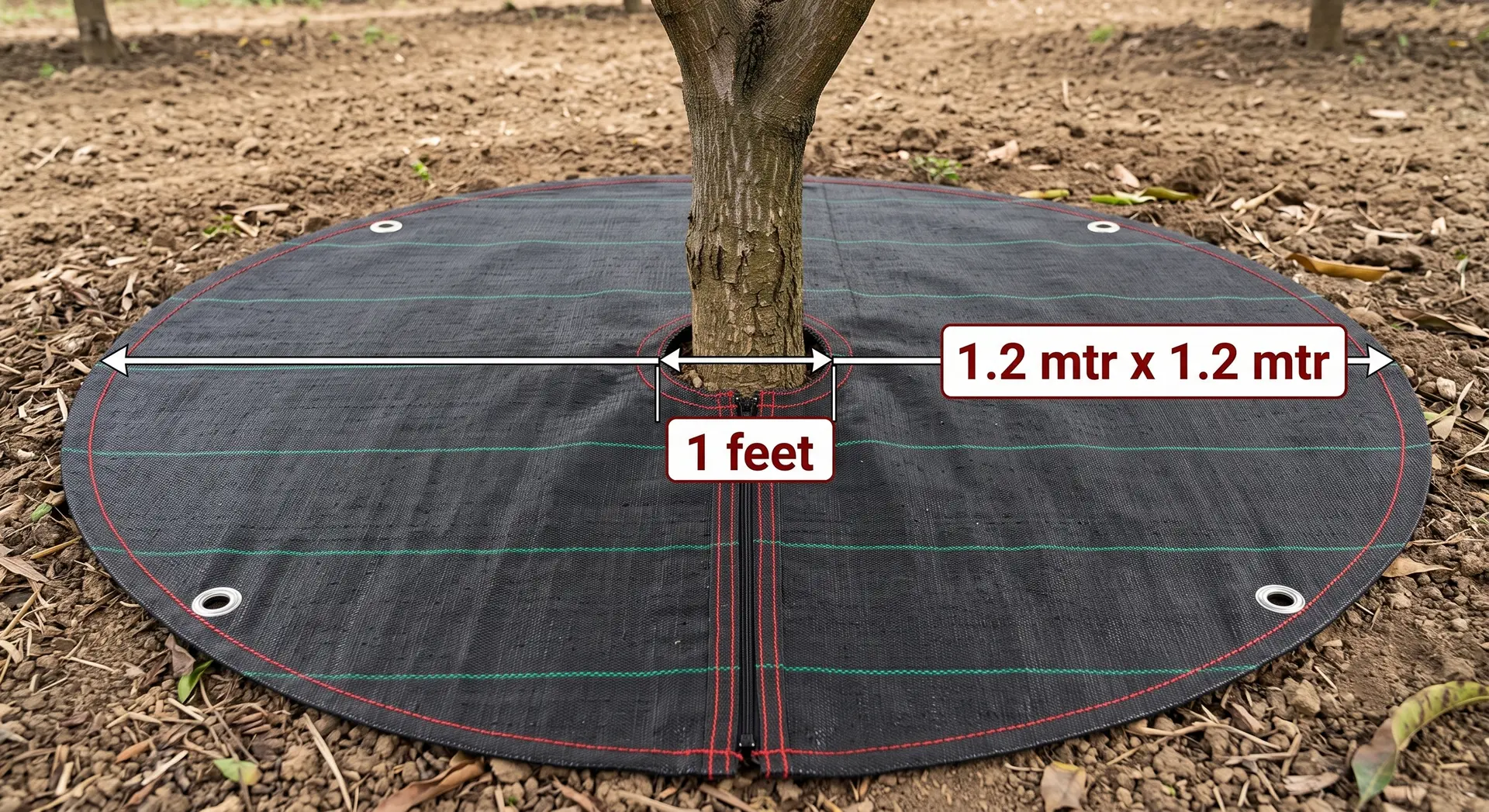
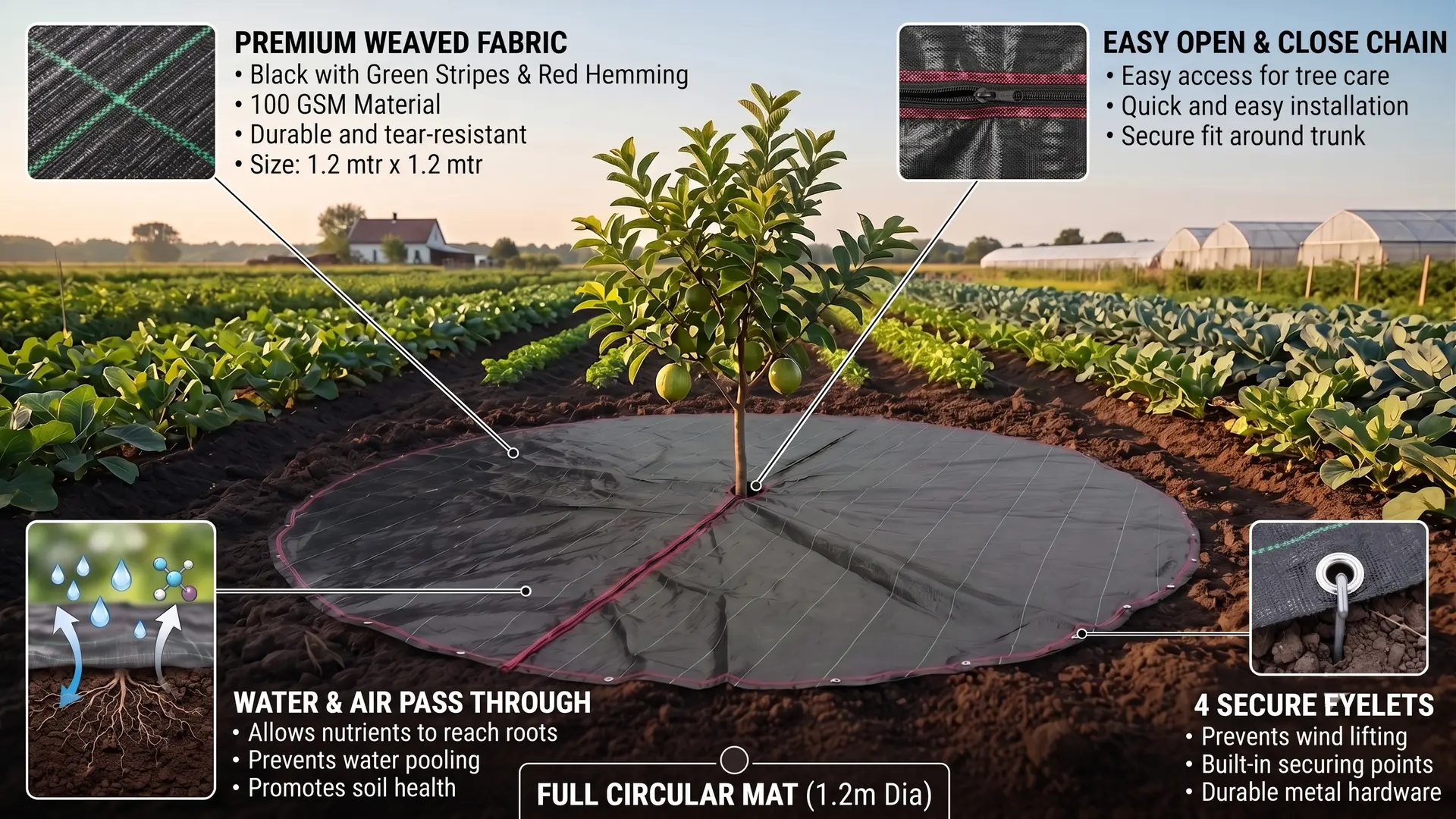
For tree crops and orchard basins specifically, the round pre-cut mat exists for this exact job: the 1.2 m round mat with chain (₹399) rings a tree basin — moisture held in the basin, basin weeds gone, and the chain holds it in place against wind. It is the cheapest orchard upgrade we sell, and our orchard guide covers the per-tree placement.
One roll, two jobs: the layout that does both
The efficient farm layout mats paths AND keeps the same stock for bed mulching in rotation. Practical pattern from customers: roll one covers the main access path and headlands permanently; rolls two and three cover the beds of the season's highest-value crop; at crop change, those two rolls lift, sweep, and move to the next block — a three-roll rotation (about ₹21,000 in 100 GSM) that keeps the farm's spine clean and its best beds mulched indefinitely. The coverage guide helps convert your actual layout into roll counts.
What it saves, honestly
Path matting kills the season's most demoralising weeding — the walking-on-flat-weeds kind — and replaces periodic path hoeing with a monthly edge check. Mulch use on beds cuts irrigation frequency noticeably in summer (covered soil loses far less to evaporation) and eliminates the annual mulch-repurchase line entirely after year one or two. Neither saving is dramatic alone; together they are the difference our weeding cost analysis keeps finding — the mat paying for itself inside the first season on the areas it covers.
Path and mulch FAQs
Can trolleys and small tractors run over weed mat paths?
Foot traffic and trolley wheels, yes comfortably — that is what 100 GSM is rated for. Repeated tractor-tyre turning on the same spot will stress any fabric; for machine headlands, either use 120 GSM or leave machine lanes unmatted.
Does path matting become slippery when wet?
Woven fabric grips better than wet soil or plastic — crews report paths are safer after rain, not worse. Silt layers make the surface slick until the next brush-down, which is the monthly maintenance habit anyway.
Can I put organic mulch on top of the mat?
Yes, and it is a good combination — the mat handles weed suppression and moisture, the thin organic layer handles looks and insulation, and because weeds cannot establish, the mulch layer decomposes slowly instead of being colonised.
Will the round mats fit young tree basins?
The 1.2 m diameter covers typical young mango, guava, pomegranate and citrus basins; for very young saplings the chain lets you cinch the ring snug around the stem. Widen or double up as the canopy grows — the orchard guide shows sizing by tree age.
How does mat mulching compare to plastic film on cost?
Film wins year one, mat wins every year after — film is repurchased annually while one quality roll serves multiple seasons. The side-by-side maths is in the comparison guide, including the disposal angle film buyers rarely budget for.
Shop the products mentioned
Premium weed control mats & jewellery — free shipping above ₹999.