
Weed Mat for Fruit Trees: Orchard & Basin Care Guide
In an orchard, the weeds that matter most are the ones circling the trunk. Basin weeds drink the irrigation meant for the tree, compete right at the feeder-root zone, and cost hoe-rounds that risk cutting shallow roots every time. A weed mat ring around each fruit tree closes that battle permanently — and it is the single most common ground-cover application on the mango, guava, pomegranate and citrus orchards we supply. Here is how to do it right.
Why tree basins deserve their own weed strategy
Basin weeds are worse than row weeds for three reasons. They sit exactly where irrigation water lands, so they are the best-fed plants in the orchard after your crop. Hoeing them means working close to the trunk where feeder roots run shallow — every careless cut costs the tree. And basin weeds regrow fastest because the basin stays moist between irrigations. Hand weeding a mature orchard basin takes 5–10 minutes per tree per round; multiply by hundreds of trees and several rounds a season and the labour bill explains itself.
The mat ring method
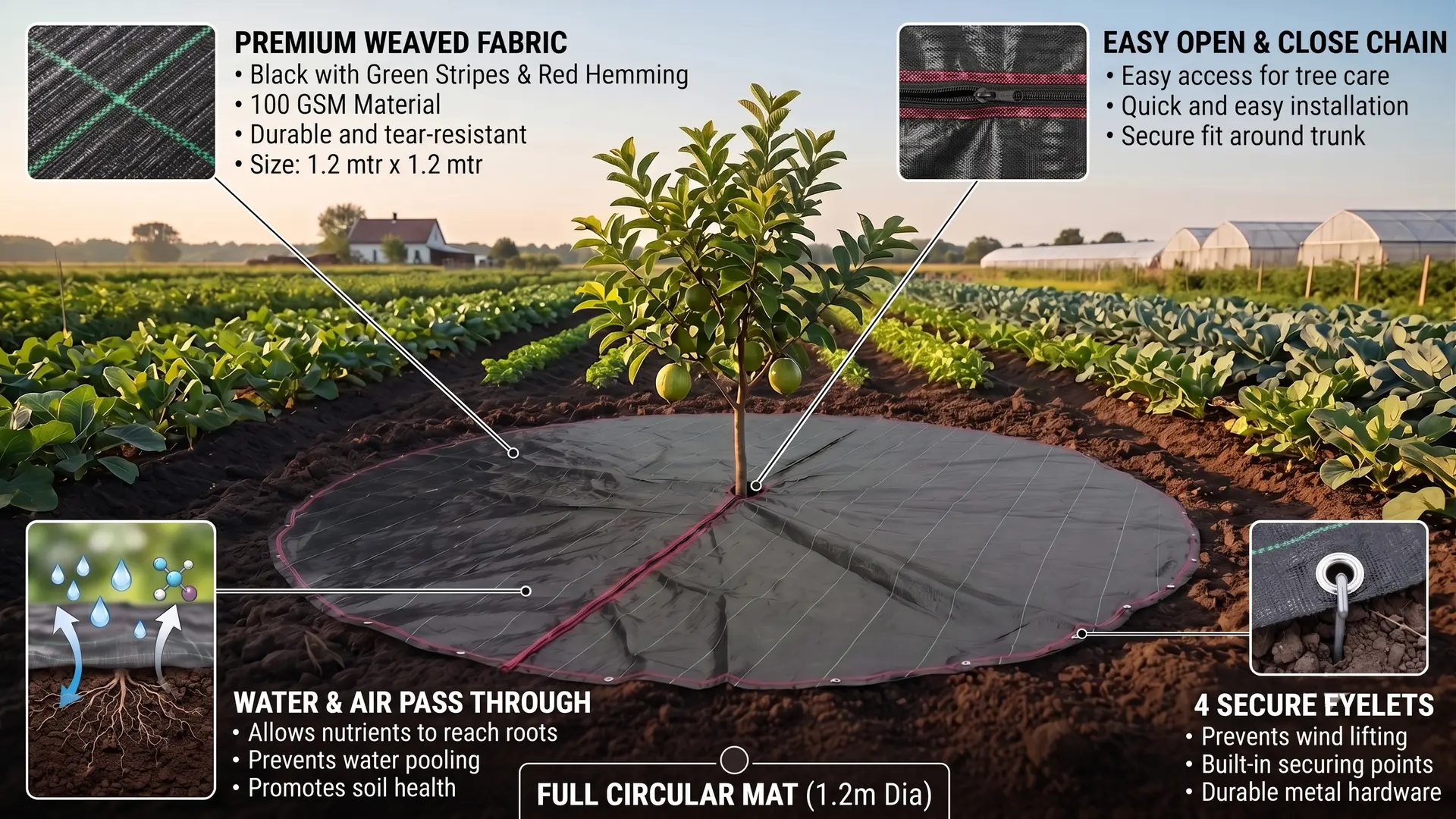
A fabric ring around the trunk blocks light over the entire basin. Nothing germinates beneath it. Irrigation passes through the weave into the soil; moisture stays more even because bare-soil evaporation stops. The trunk collar stays dry — itself a disease-avoidance win in papaya, citrus and guava where collar rot follows wet trunks.
Two implementation routes:
- Cut squares from a roll: A 1.2x1.2 m square (or circle) from a 100 GSM roll covers young-tree basins; slit to the centre, slide around the trunk, pin the edges. Cheapest route at scale — one roll yields ~80 rings.
- Purpose-made round mats: The 1.2 m round mat with chain edge drops over the basin with no cutting at all — the chain border holds the shape flat around the trunk without pins. For plantations and gardens wanting clean, fast installation per tree, these are the workhorses.
Sizing rings by tree age
- Year 1–2 plantings: 0.9–1.2 m across. Cover the watering basin only; leave the rest of the interspace for now.
- Year 3–5: Expand to 1.2–1.5 m as the canopy and feeder roots spread. If you started with roll-cut squares, lay a bigger ring over the first — no need to lift the old one.
- Mature trees: 1.5–2 m diameter, or continuous strips along tree rows once canopies close. At strip stage, the per-metre maths from the roll coverage guide applies.
Leave 10–15 cm of bare soil immediately around the trunk. Fabric touching the trunk holds moisture against bark and invites collar problems; the small bare collar ring is deliberate, not laziness.
Water savings nobody budgets for
Bare basin soil in Indian summer loses a shocking share of irrigation to direct evaporation. Under fabric, evaporation nearly stops; soil moisture stays even between irrigations, and growers routinely report stretching irrigation intervals in the first dry season after installing rings. On drip-irrigated orchards this shows up as fewer pump hours for the same soil moisture — a saving that keeps arriving every season for the life of the fabric. Combined with the weeding labour it replaces, the ring's payback typically lands within the first year even at ₹399 per mat; the cost-benefit guide runs the general case.
Installation notes specific to basins
- Shape the basin first: Finish your basin shaping (slope to the trunk side for flood basins, flat for drip) before laying fabric. Redoing basins later means lifting rings.
- Remove perennial weeds before laying: Nut grass and Bermuda grass rhizomes under fabric stay dormant but not dead; clear the worst first. Annual weeds are simply finished by the cover.
- Pin or chain the edges: On sloped basins, pin roll-cut squares every 50 cm. Chain-edge mats hold themselves — that is their whole design purpose.
- Fertigation unaffected: Drip lines run on top of the fabric; nutrients pass through with the water. No changes to your schedule.
Frequently Asked Questions
Which weed mat is best for fruit tree basins?
100 GSM woven fabric for standard basins; round 1.2 m chain-edge mats where you want pin-free installation. High-UV regions benefit from 120 GSM rings.
Can weed mat touch the tree trunk?
Leave a 10–15 cm bare collar around the trunk. Fabric held against bark keeps it wet after irrigation and invites collar rot, especially in citrus and guava.
Does a basin mat stop water reaching roots?
No — woven ground cover is water-permeable. Irrigation and rain pass through; evaporation is what gets blocked, which is why basins under mat stay moist longer.
How long do tree basin mats last?
4–5 seasons for 100 GSM outdoors, longer for 120 GSM. Partial shade from the canopy extends life further — the lifespan guide details the factors.
For the wider orchard system — rows, paths and interspaces — the farm cost guide extends this to whole-plantation coverage, and the buying guide sizes the order.
Shop the products mentioned
Premium weed control mats & jewellery — free shipping above ₹999.